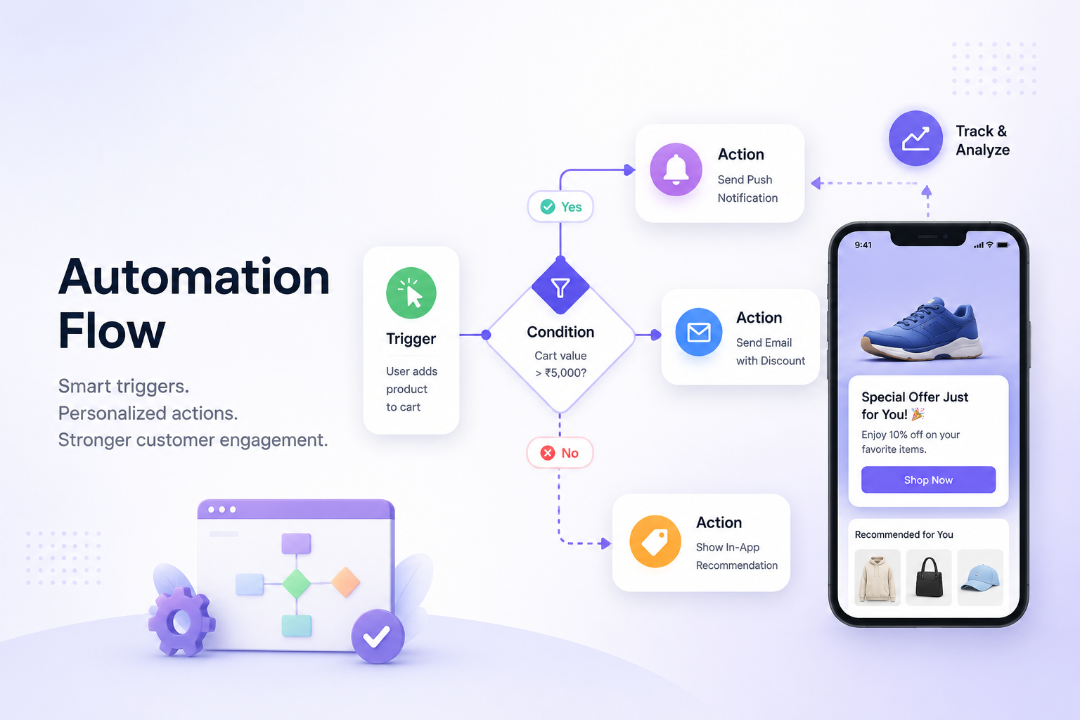
TL;DR: Your app should react the moment a customer acts. Evlop's Automation Flow triggers real-time popups & pushes — no code, no delay.
Every automated journey is built using a simple framework:
- Trigger: The specific behavior (e.g., logging in, adding to cart, going idle).
- Condition: Who qualifies (e.g., VIP status, cart value over $50).
- Action: The outcome (e.g., a push notification, in-app popup, or interactive choice).
With built-in Delay and Throttle nodes, you can flawlessly time your messaging to eliminate notification fatigue. Everything runs on a visual canvas, requires zero code, and updates live without requiring an App Store review.
Why Shopify apps lose revenue without automation
A customer adds something to their cart, gets distracted, and closes the app. That happens thousands of times a day across thousands of stores, and most of the time, nothing happens next.
But every so often, a few hours later, that same customer gets a message that feels eerily well-timed — not a generic "you left something behind" blast, but something that arrives at the right moment and says the right thing. A reminder, a discount, a nudge. And they go back and finish the purchase.
That wasn't luck. That was automation running exactly as designed.
Most Shopify merchants understand, in theory, that timing matters. The right message at the right moment converts. The same message sent too early, too late, or to the wrong person doesn't just fail to convert — it trains your customers to ignore you. And yet the tooling most merchants use for this kind of engagement is either too manual to scale, too rigid to respond to real behavior, or too disconnected from the actual in-app experience to feel relevant.
Email sequences fire on a schedule. SMS blasts go to everyone. Shopify Flow handles backend order logic beautifully, but it doesn't know what a customer is doing inside your mobile app right now.
That gap is where most retention revenue gets left on the table.
Your app is watching. But is it doing anything about it?
Every session in your mobile app is a stream of signals. A customer logs in. They browse a collection. They add something to cart. They sit on a product page for three minutes. They leave without buying. They come back the next day and do the same thing again.
These are not passive events. They are declarations of intent. And an app that collects these signals without acting on them is leaving a very specific kind of money on the table — not the broad attrition you can attribute to a bad homepage, but the quiet, recoverable revenue of customers who were genuinely interested and needed one well-timed thing to tip them over.
The average mobile app treats all of this as background noise. Notifications go out on a broadcast schedule, not in response to what any specific customer just did. In-app messages appear on a timer, not because something meaningful just happened in the customer's session. The experience is reactive in name only.
A truly reactive app doesn't wait for you to run a campaign. It responds to your customers the moment behavior worth responding to occurs.
This same logic extends beyond triggers and actions — Evlop's 'App with many Faces' takes it further, reshaping the entire app experience, not just sending a message, based on who's using it.
How Evlop's Automation Flow works (Trigger, Condition, Action)
Evlop's Automation Flow is a visual, no-code builder that lets you define exactly what your app should do when a customer does something specific inside it.
The logic is simple on the surface, and genuinely powerful underneath. Every automation is built from three components: a trigger, an optional condition, and an action.
The trigger is what starts the flow. It could be a customer logging in, adding a product to cart, reaching the checkout screen, removing an item from their wishlist, opening the app after a period of inactivity, or any number of other behavioral events that span the full customer journey. The trigger sits silently in the background and fires the moment the specified event occurs.
The condition is a filter. Once a trigger fires, you can narrow down which customers the flow should actually respond to. Is this a VIP customer? Is their cart value above $50? Are they a logged-in user or a guest? Are they browsing from a specific country? Conditions prevent your automation from treating a first-time visitor the same way it treats your top 10% of buyers. They are the mechanism that makes an automated response feel like a considered one.
The action is what happens. Send a push notification directly to the customer's lock screen. Display an in-app popup with a message, an image, and a button that takes them somewhere specific. Navigate the customer directly to a product, a collection, their cart, or a custom URL. The action is the moment your automation becomes visible to the customer — and because it was triggered by something real, it has a reason to exist.
You can run as many flows simultaneously as your strategy requires. They operate independently, never interfering with each other. And because everything lives in Evlop's dashboard rather than your app's codebase, you can edit, pause, or disable any flow instantly — no App Store review, no developer involved.
The canvas: Inside the no-code automation builder
The Automation Flow builder operates on a visual canvas — a drag-and-drop workspace where each component of your logic appears as a connected node. You can see the entire structure of a flow at a glance: trigger feeding into condition, condition branching into two paths, each path leading to its own action. The logic is explicit and readable without requiring a single line of code.
This matters for a reason that goes beyond convenience. When the structure of your automation is visible, it is also auditable. You can look at a flow and immediately ask: what happens to customers who fail the condition? What action fires if they pass? Where does this journey end? A text-based rule set buried in a configuration panel doesn't give you that. The canvas does.
Node types available within the visual builder include:
Condition Check(The Filter): Branches your flow based on real-time data. You can filter by product attributes(price, SKU, collection), session context (language, country), customer history (order count, lifetime value, guest vs. repeat buyer), and cart state. Combine them usingAND,OR, orNOTlogic for surgical precision.Navigation(The Friction Remover): Instantly routes the user to a highly specific destination inside the app—like a collection, their wishlist, a shopping cart, or a custom page or URL—at the exact millisecond they are ready to act.Show Popup(The Conversion Kick): Displays a beautifully styled in-app message with custom images, headlines, and action buttons. It's the perfect mechanism for surfacing timely flash sales or personalized discount codes.Options(The Two-Way Conversation): Lets you ask users a question and present interactive choices. Each selection creates a distinct branch on the canvas. Example: Give them choices like "View New Arrivals" or "Claim 10% Off" and map out entirely separate customer journeys from a single trigger.Send Push Notification(The Re-Engager): Reaches customers directly on their lock screens outside of an active session. Use this node to win back idle carts, remind users of abandoned wishlists, or wake up users who haven't opened the app in weeks.Delay(The Timing Guard): Introduces a deliberate pause (measured in minutes, hours, or days) before the next action fires. This ensures your app feels intuitive and helpful, rather than intrusive and creepy.Throttle(The Burnout Safeguard): Limits how often a flow can execute for the same customer over a given timeframe. If a user repeatedly adds and removes an item from their cart, a throttle node ensures they only see your promotional offer once.
Example: Automated cart recovery flow
Here is a concrete example, built in Evlop's automation canvas.
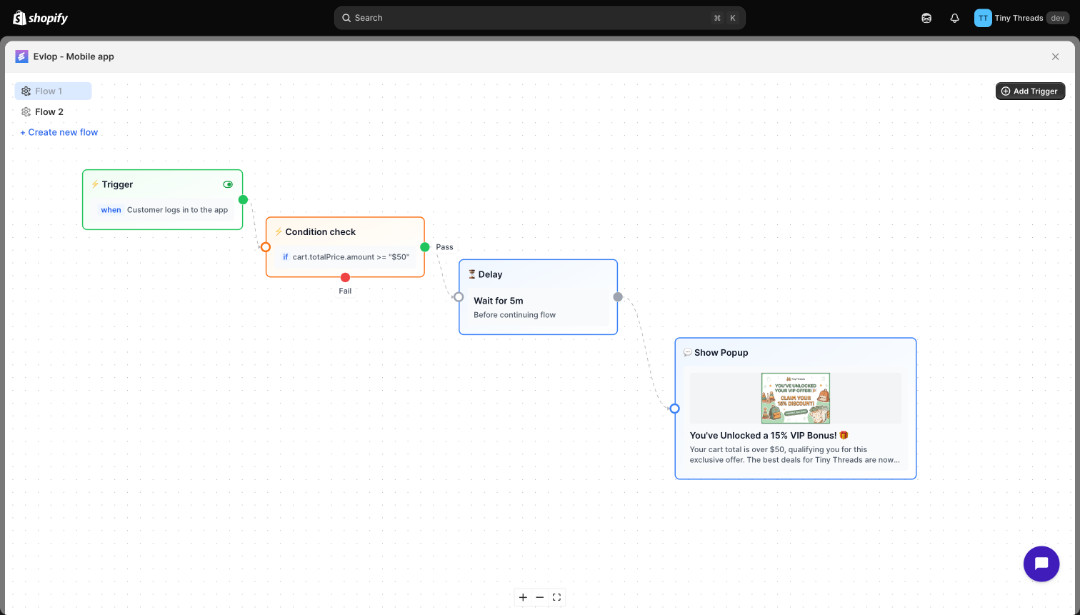
The Customer Journey Broken Down:
Here's what this looks like as an actual automation flow inside a Shopify mobile app:
- The Trigger: A customer logs into the app.
- The Condition Check: Automation Flow instantly checks their current cart. Is it $50 or more?
- The Strategic Pause: If they qualify, the flow doesn't interrupt them right away. A Delay node waits 5 minutes, giving the customer time to keep browsing and reach a natural stopping point.
- The High-Value Action: After the delay, a perfectly timed Show Popup appears with a tailored discount code (
SAVE15), paired with a Navigation button that sends them straight to checkout with the code already applied.
What if they don't qualify? If their cart is under $50, the flow branches down a different path automatically. You could target them with a lighter-touch popup highlighting your free shipping threshold, or simply do nothing at all, since not every path needs an action.
Because this entire logic lives on a visual canvas, you can adjust delay times, swap out the discount code, or update the popup image instantly. The moment you click save, it goes live. No app deployments, no App Store review delays, no engineering required. instantly. The moment you click save, it goes live—no app deployments, no App Store review delays, and no engineering required.
Scaling automation as your Shopify app grows
The honest appeal of behavioral automation is that it doesn't ask you to be a certain size before it starts paying off. It asks you to start, and then it compounds.
A brand-new mobile app with a few dozen daily sessions still has customers adding to cart and walking away. A single flow — cart value over $X triggers a delayed reminder with a discount — recovers some percentage of those customers from day one. That is real revenue, even at a small scale, and it costs nothing to leave running in the background while you focus on growing traffic.
What changes as your app grows isn't whether automation works. It's how much of it you need. Ten flows running in parallel, each tuned to a different segment and a different moment in the journey, only becomes necessary once you have the volume and the customer variety to justify it. Evlop is built for that progression: start with one simple flow, watch it work, and add complexity exactly when your traffic calls for it.
And because every flow's performance shows up in Evlop's Analytics dashboard, you'll always know which automations are actually driving revenue.
If you're still deciding which platform to build on, our comparison of the best Shopify mobile app builders breaks down how Evlop stacks up against Tapcart, Shopney, and others.
That's the real shape of the opportunity. Every customer who logs in, browses, or adds to cart without buying is a signal your app can already see. Automation Flow is what turns "I noticed" into "I did something about it" — automatically, at whatever scale your store is operating at today, and at whatever scale it grows into next.
The compounding effect
Here is the thing about behavioral automation that does not show up in a single conversion metric.
Every well-timed response your app delivers is a small trust signal. A customer who receives a relevant popup at a natural moment in their session does not just convert more often. They form a different relationship with the app. The app feels like it is paying attention. It feels like it is built for them.
That feeling is the foundation of the retention rates that separate mobile-first brands from everyone else. It is not built by a single campaign. It is built by a system that responds correctly, consistently, at scale.
An app that never sleeps, never forgets what a customer was looking at, and always knows when to say something — that is not a feature. That is a competitive advantage.
Not sure Evlop is the right fit yet? See how it compares to other Shopify mobile app builders before you commit.
If your store is ready to build that, the canvas is waiting. Get started with Evlop