Take a familiar example.
Think about how much time you spend on YouTube.
Now ask yourself: how much time would you spend on YouTube if every time you opened it, you saw the exact same list of videos as everyone else in the world? No recommendations. No watch history. No "because you watched this." Just a single fixed homepage, the same for a 14-year-old in Seoul, a 45-year-old in Lagos, and a software engineer in Toronto. All of them, same videos, same order, every time.
You would stop opening it within a week.
YouTube is one of the most-used apps on the planet not because it has the most content, but because it shows each person a completely different version of itself. The app you open is not the same app your colleague opens. It has learned what you watch, how long you watch it, what you skip, what you come back to. It has become a version of itself built specifically for you. That is why you keep going back.
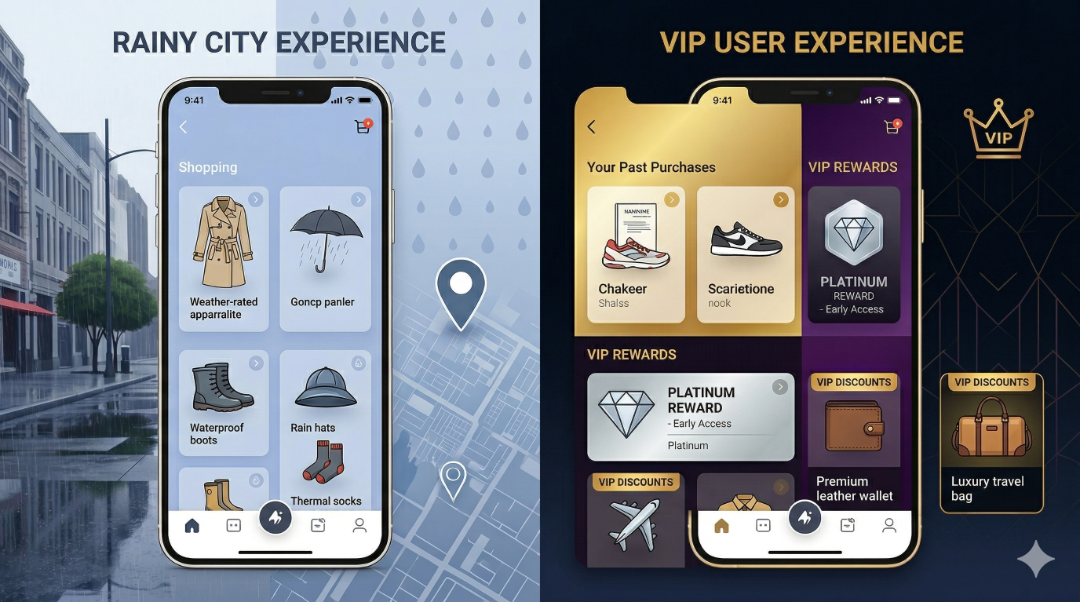
Most Shopify mobile apps do the opposite. They are a fixed storefront: same homepage, same featured collections, same layout, same product order, for every single customer who opens them. Whether it is a first-time visitor from Manchester browsing in the rain or a loyal buyer in Dubai who has purchased seventeen times, they both see the identical app.
Your app looks the same to everyone. That's a problem.
Getting someone to install your app is genuinely hard. You are spending on paid acquisition, working the App Store algorithm, running email campaigns, and banking on enough brand equity to convince someone to give up real estate on their phone. That is a meaningful investment of time and budget.
And then they open your app and see the exact same homepage as a first-time visitor who clicked a discount ad twenty minutes ago.
That gap is where acquisition spend stops paying off. Not dramatically — there is no single moment where you can point and say "there, that is where we lost them." It happens slowly, session by session. A homepage that feels irrelevant. A recommendation that misses. A push notification dismissed because it had nothing to do with what that customer actually buys. Each one is a small signal that this app was not really built for them.
The retention data tells the same story. The average app loses more than 70 percent of its users within the first week after install. For e-commerce, that attrition is a direct hit to conversion rates, order frequency, and ultimately LTV — the number every growth team is trying to move.
The underlying problem is that a static storefront makes a silent assumption: that all your customers are essentially the same. They are not. Your highest-value customers have different purchase cadences, different category loyalties, and different session behaviors than everyone else. Showing them the same experience as a brand-new visitor means you are not really optimizing for anyone.
Think about what that looks like in practice. A customer who has bought from you eight times does not need to be introduced to your brand. A buyer who only shops your premium range should not have to wade through entry-level products to find what they want. Someone browsing late on a Friday night is in a different mindset than someone opening the app on a Tuesday morning before work. These are not edge cases. This is your actual customer base, every day.
When the app does not reflect who the person is, you create friction. Friction reduces session depth. It suppresses add-to-cart. It quietly moves people toward uninstalling — and no re-engagement campaign fully makes up for a customer who has already checked out.
An app that looks the same to everyone is not really doing its job. It is a pamphlet with a download button.
Still deciding which platform to build your app on? Our guide to the best Shopify mobile app builders compares Evlop against Tapcart, Shopney, and others.
The App with Many Faces: A different way of thinking about mobile commerce
The name was inspired by the Faceless Men — a guild of assassins from the fantasy series Game of Thrones. Their defining ability is that they have no fixed identity of their own. They can become anyone: adopting a face, a voice, a manner so completely that the person standing before them sees exactly who they need to see. The Faceless Men are not shapeless or formless. They are precise. They study who they are meeting and become the most relevant version of themselves for that person.
That idea, applied to a mobile app, is the App with Many Faces.
An app with many faces does not mean an app with no design or no brand. It means an app whose content, layout, and featured products shift to match whoever is opening it. Your brand identity stays intact. What changes is what each customer sees within it.
Personalization at this level has been standard in consumer tech for years. Netflix, Spotify, and Amazon figured it out a long time ago — not because they were chasing a trend, but because a fixed experience actively cost them revenue. The interesting question is not why it works. It is why most Shopify mobile apps still have not adopted it — and what it takes to change that.
The data points that drive personalization
Personalization is only as good as the signals feeding it. The right signals vary by store, but the most meaningful ones tend to fall into a few categories.
Purchase history is the clearest window into what a customer actually values. A customer who has purchased from your knitwear collection twice should not open your app to a homepage leading with summer dresses. Their history tells you what they care about, and using that to shape what they see first turns your homepage from a catalogue into a curated space. Purchase history also reveals cadence: a customer who buys every six to eight weeks is a replenishment buyer. An app that recognizes that pattern and surfaces the right products at the right moment in the cycle is doing something a static storefront simply cannot.
Real-time weather and forecast data is one of the most underused signals in mobile commerce. If it is 4 degrees and raining in Edinburgh and a customer opens your clothing app, showing them your linen collection is a missed opportunity. The customer in Barcelona opening the same app on the same day lives in a different reality, and they should see a different app. Weather is not just about temperature. It is about what a customer actually needs right now, and what they are likely to need in the next few days. A well-configured app can surface outerwear when a cold front is approaching, before the customer has even started thinking about it.
In-app usage patterns reveal intent and purchase readiness in ways that purchase data alone cannot. A customer who has opened the app eleven times in the past month without purchasing is telling you something: they are interested, but unconvinced. That customer needs a different experience than one who converts on nearly every session. The high-intent but unconverted customer might benefit from seeing social proof, editorial content, or lower-commitment entry points. The frequent buyer probably wants to see new arrivals and premium lines front and center. An app that reads these patterns and adjusts accordingly is actively working to recover revenue that would otherwise go unspent.
Onboarding data is the cleanest and most honest signal available, because the customer provides it voluntarily. A well-designed onboarding flow asks a few well-chosen questions: What are you shopping for? Who are you shopping for? What sizes do you typically need? The customer answers in a few taps, and from that first session, the app already knows enough to be useful. This matters most in the early life of the customer relationship, before behavioral data has had time to accumulate. A customer who has told you they shop for children aged 3 to 6 should never receive a push notification about your men's fragrance line. That kind of misfire does not just fail to convert. It erodes trust.
Personalization is not just what they see. It is when they hear from you.
The same logic that applies to the in-app experience applies to push notifications. A notification sent at the wrong time, about the wrong thing, trains customers to ignore you. A notification sent at the right moment, about something genuinely relevant, drives a session that would not otherwise have happened.
Time-aware, behavior-driven notifications are a core part of what makes an App with Many Faces work. A customer who has been browsing a specific jacket for three sessions without buying is a candidate for a well-timed nudge, not a blanket discount blast. A customer who just hit a loyalty milestone is a candidate for a message that rewards rather than sells. A customer who typically purchases every eight weeks, and whose last purchase was seven weeks ago, is a customer whose next session is worth prompting.
These are not spray-and-pray notifications. They are signals-based communications that feel less like marketing and more like a store that actually pays attention. And that distinction is exactly what separates brands with strong app retention from brands with strong uninstall rates.
For a deeper look at notification strategy specifically — timing, segmentation, and frequency — see our eCommerce push notifications guide.
How this is built in Evlop
Personalization in Evlop is not powered by a single feature toggle. It is the result of several capabilities working together — each one handling a different layer of the experience. Here is how each piece fits in.
Conditionally visible sections
Evlop allows individual homepage sections, banners, collection carousels, and content blocks to be shown or hidden based on conditions you define.
A section featuring lightweight summer pieces can be set to appear only for customers in locations where the temperature is above a threshold. A loyalty-exclusive banner can be configured to show only to customers who have reached a certain tier. A "Recommended for You" section can surface only after a customer's second purchase, once there is enough data to make the recommendations meaningful.
Conditional visibility is the mechanism that turns a single app into many different apps, each shaped to the customer opening it. It does not require rebuilding the storefront for each segment. It requires defining the rules once, and letting the system apply them at scale.
Automation flows for in-app messages and push notifications
Evlop's automation flows allow you to define trigger-based communications that fire based on customer behavior, time elapsed, or external conditions.
In-app messages can be configured to appear when a customer reaches a specific point in a session: after browsing a product category for a set number of sessions, after adding to cart without completing purchase, or after reaching a loyalty milestone. These messages feel contextual because they are. They are not interruptions. They are responses to what the customer is already doing.
Delayed push notifications extend this logic outside the app. A customer who browses a product and does not purchase can receive a notification twelve hours later. A customer who has not opened the app in three weeks can receive a re-engagement message timed to a moment when they are statistically more likely to be receptive. The timing and content of these notifications are defined in the automation flow, not sent manually.
Custom blocks
Evlop's pre-built content blocks cover the majority of standard use cases. For brands where the standard blocks do not go far enough, custom blocks allow you to define entirely new content types and surface them within the app's layout.
A brand that wants to show a personalized editorial content feed based on purchase history can build that as a custom block. A brand that wants to display a dynamic size guide based on the customer's onboarding answers can do the same. Custom blocks exist for the cases where a brand's personalization vision is specific enough that a pre-built component is not the right fit.
Onboarding screens
The onboarding flow is where the customer relationship begins, and it is the first opportunity to collect zero-party data directly from the customer. In Evlop, onboarding screens are fully configurable. You design the questions, choose the interaction format, and decide what happens to the answers.
The goal is not to collect as much data as possible. It is to ask the two or three questions whose answers will meaningfully change what the customer sees. A children's clothing brand might ask for the ages of the children being shopped for. A fragrance brand might ask whether the customer is shopping for themselves or as a gift. A fitness brand might ask about the customer's primary training focus. The answers flow directly into the personalization logic that shapes the rest of the experience.
Server-side automation with external APIs
Not all personalization signals live inside your store. Some of the most relevant context for a customer comes from the world they are in right now — and Evlop can pull that in.
Server-side automation flows connect to external APIs and use the data they return to update what each customer sees in the app. The logic runs continuously in the background, applying rules you define, without requiring manual changes to the storefront. This is what allows the app to respond to conditions outside your store — not just who the customer is, but what is happening around them.
When is the right time to build this?
Personalization at this level is not the right investment for every Shopify store, and it is worth being direct about that.
The returns on an App with Many Faces are real, but they are proportional to the volume of customers moving through the app. If your store generates less than $200,000 per month in revenue, the lift from hyper-personalization is unlikely to justify the time and configuration effort required to build it properly. At that revenue level, foundational improvements to the app experience, better product photography, cleaner navigation, faster load times, will typically move the needle more.
At $200,000 per month and above, the math changes. A modest improvement in retention rate, push notification open rate, or average session-to-purchase conversion rate produces meaningful absolute revenue. The personalization system pays for itself, and then compounds.
Starting simple and adding layers
Personalization does not have to be implemented at full complexity from day one. Evlop's architecture supports a tiered approach that allows brands to start where it makes sense and add sophistication as the data and the business warrant it.
At the simplest level, personalization can be driven by customer tags or metafields already present in Shopify. If you have a loyalty tier system, or if you segment customers by purchase frequency or category affinity, those tags can immediately drive conditional visibility rules in the app. This level requires minimal configuration and can be live quickly.
The next level introduces behavioral signals: browsing history, session patterns, and cart behavior shaping what each customer sees. This requires more configuration but produces a meaningfully more responsive app.
The most advanced implementations layer in external data, such as weather and location, alongside onboarding data and behavioral signals, to produce an experience that adapts in real time to both who the customer is and what is happening in their world. This is the full App with Many Faces, and it is the level where the returns are most pronounced.
The right starting point depends on your data maturity, your product range, and your customer base. Evlop's team works with each brand to identify where the highest-leverage entry point is, so the first implementation delivers value rather than complexity.
What this looks like in practice
Consider a fashion brand working with Evlop, and a customer of theirs in Glasgow.
It is late October. The customer has purchased twice before, both times from the brand's knitwear collection. She opens the app on a Sunday afternoon. It is 8 degrees outside, with rain forecast for the week.
A standard app shows her the same homepage as everyone else. A "New In" section featuring the brand's latest drop across all categories. A banner promoting a sale on summer dresses.
Her Evlop-powered app shows her something different. The homepage is led by a "For You" section drawing from the knitwear and outerwear collections she has shown affinity for. The hero banner references the current season. Product ordering prioritises her likely size based on past purchases. A push notification she received that morning highlighted a new waterproof jacket and mentioned the weather.
She buys the jacket.
The same app, the same day, shows a customer in Lisbon a completely different experience: lighter layers, different imagery, a different featured collection. The app was built to respond to different signals for different people.
For this brand, the meaningful signals were purchase history, weather, and size inference. For a different brand with a different customer, the right signals would look different. That is the point. The App with Many Faces does not have a universal configuration. It has a methodology, and the methodology is built around your store.
Here's the thing
The best retail experience you have ever had probably involved someone who paid close attention to you, who listened, remembered, and made you feel like the store understood what you needed before you had fully articulated it yourself.
That experience is rare in physical retail because it depends on people, and people have limits. In mobile commerce, those limits do not have to exist. An app with many faces is an app that can be everything to the customer standing in front of it.
If your store is at the stage where this conversation makes sense, we would be glad to have it. Start the conversation at evlop.com.