
Mobile apps have become one of the most valuable owned channels for Shopify merchants, especially as more than 60% of Google searches now end without a click, and AI-powered search tools continue to change how people discover products.
Unlike traffic from search engines or social platforms, mobile app users are customers you can reach and engage directly through push notifications that have a 90%+ open rate, better than email. Moreover, customers who download your mobile app tend to make more frequent purchases because downloading it is an active decision to keep your store on their phone.
Building a native mobile app used to require a development team, months of timeline, and a budget that most Shopify stores could not justify a few years ago. Today, you can launch a professional iOS and Android mobile app for your Shopify store, without even writing code, often in a matter of hours or days rather than months.
But not all of these Shopify mobile app builders work the same way, and the differences become clear only after you start using them. Some charge flat monthly fees while others take a percentage of every sale made through your app, which can quietly eat into your margins as your app revenue grows. Customization depth varies widely, with some platforms offering enough flexibility to build an app that truly reflects your brand, while others lock you into rigid templates that look like every other Shopify app on the App Store.
Features that should be standard, like unlimited push notifications, are often capped or charged separately, and many platforms require paid add-ons or third-party integrations for functionality like loyalty programs, reviews, or back-in-stock alerts. And while every platform advertises seamless Shopify integration, the depth of that integration varies significantly in how it syncs inventory, orders, and customer data in real time.
In this guide, we break down the key factors to consider when choosing a Shopify mobile app builder and cover the best options available, starting with our own.
Factors to Consider When Choosing a Shopify Mobile App Builder
Choosing a Shopify mobile app builder is not just about finding a platform that can convert your store into an app. Most platforms can do that.
The differences lie in how they charge you, how much control they give you over the design, what features are actually included versus sold separately, and how deeply they integrate with Shopify.
These factors determine whether you end up with an app that drives revenue or one that becomes an expensive project you eventually abandon.
Pricing Structure
Shopify mobile app builders typically charge in one of two ways.
Some platforms use a flat monthly fee, which means you pay the same amount regardless of how much revenue your app generates. Others charge a base subscription plus a success fee, which is a percentage of every sale made through your app.
Success fees might seem small at first, but they can add up to thousands of dollars per month as your app revenue grows. For example, if your store generates $50,000 per month in app sales, you would pay an additional $500 to $1,000 in success fees on top of the monthly subscription fee, if the success fee is just 1% or 2%.
The more successful your app becomes, the more you pay, which effectively penalizes you for building a high-performing mobile channel.
Dynamic pricing models like this also make it harder to plan your expenses. Your costs fluctuate month to month based on sales volume, which complicates budgeting and forecasting, especially for growing stores where revenue can be unpredictable.
A flat monthly fee, on the other hand, gives you a fixed cost you can plan around regardless of how well your app performs. You know exactly what you are paying each month, and your margins stay consistent as revenue scales.
Customization Depth
Some Shopify mobile app builders give you granular control over your app's design, letting you customize layouts, fonts, colors, navigation, and individual page elements to match your brand. Others offer a handful of templates with limited flexibility, which means your app ends up looking like every other eCommerce app using the same builder.
The level of customization matters because your mobile app is an extension of your brand, not just a functional tool for placing orders. If your website has a distinct look and feel, your app should reflect that. Customers who download your app expect a consistent experience, and a generic-looking app can undermine the brand equity you have built elsewhere.
When evaluating customization options, look at what you can actually change. Can you customize the home page layout and add sections like featured collections, promotional banners, or video content? Can you adjust how product pages display images, descriptions, and reviews? Can you modify the navigation structure and menu design?
Some platforms advertise customization but only let you swap colors and upload a logo, while others give you a drag-and-drop builder that lets you control nearly every element of the app. The difference between the two can be significant when you are trying to create an app that feels like yours rather than a template with your logo.
Built-in Features vs. Paid Add-ons
Features like push notifications, abandoned cart recovery, back-in-stock alerts, wishlist functionality, and loyalty programs are what make a mobile app more effective than a mobile website. These are the tools that let you re-engage customers, recover lost sales, and build repeat purchase behavior.
The question is whether these features come included with your platform or whether you have to pay extra for them.
Some platforms include a full suite of conversion and engagement features out of the box, even on their lower-tier plans. Others use a tiered model where basic functionality is included, but the features that actually drive revenue, like automated push notification campaigns or loyalty rewards, are reserved for higher-priced plans or sold as add-ons.
In some cases, you need to integrate third-party apps to get functionality that other platforms include natively, which adds complexity and additional monthly costs.
Integration Depth
Every mobile app builder claims to integrate with Shopify, but the depth of that integration varies significantly.
At a basic level, integration means your products, collections, and prices show up in your app. But a deeper integration means your inventory levels sync in real time, orders placed through the app flow directly into your Shopify dashboard, customer accounts and order history carry over seamlessly, and discount codes and gift cards work the same way they do on your website.
The "Built for Shopify" badge is one indicator of integration quality. Shopify awards this designation to apps that meet their highest standards for performance, security, and seamless data sync. It also means the app has been reviewed by Shopify's team and follows their best practices for how data is handled between your store and the app. Not every mobile app builder has this badge, and the ones that do have gone through a more rigorous approval process.
Beyond the badge, pay attention to how the platform handles syncing. Does inventory update in real time or on a delayed schedule? If a product sells out on your website, how quickly does that reflect in your app? What happens when a customer starts a cart on your website and then opens your app?
Platforms with shallow integrations can create problems like overselling out-of-stock items or forcing customers to manage separate accounts for your website and app. A deeply integrated platform eliminates these friction points and makes your app feel like a native extension of your store rather than a separate system.
App Store Submission Support
Getting your app approved on the Apple App Store and Google Play is not as simple as uploading a file and waiting for approval. Both platforms have specific guidelines around design, functionality, content, and metadata that your app must meet before it can go live. Apple, in particular, is known for a strict review process that can reject apps for issues ranging from missing privacy policies to UI elements that do not meet its standards.
Some Shopify mobile app builders handle the entire submission process for you. They prepare the required assets like app icons, screenshots, and descriptions, configure the technical settings, submit the app on your behalf, and manage any back-and-forth with Apple or Google if issues come up during review. Others provide guidance and documentation but leave the actual submission to you, which means you need to create your own developer accounts, navigate the submission interfaces, and troubleshoot any rejections yourself.
If you have never submitted an app to the App Store or Google Play, the learning curve can be steep, and the process can take weeks if you run into problems. Even small mistakes, such as incorrect screenshot dimensions or a missing privacy policy link, can lead to rejection and delay your launch.
A platform that offers hands-on submission support removes this friction entirely and gets your app live faster. For most Shopify merchants who want to focus on running their store rather than learning the intricacies of app store guidelines, this support is worth prioritizing.
Best Shopify Mobile App Builders
Below, we cover the best Shopify mobile app builders available, starting with Evlop. For each platform, we explain what it does well, where it falls short, and what types of merchants it works best for. We evaluated these platforms based on the factors outlined above, including pricing structure, customization depth, built-in features, Shopify integration, and support for app store submissions.
1. Evlop

Evlop is our Shopify mobile app builder, and we built it specifically for merchants who want a professional mobile app without the trade-offs that come with most platforms. It builds native iOS and Android apps that sync automatically with your Shopify store, and the entire setup process can be completed in hours rather than weeks.
Most Shopify mobile app builders force you to choose between flexibility and simplicity. Platforms with deep customization options often require technical skills or a lengthy setup process, while platforms that are easy to use tend to lock you into rigid templates with limited control over the final product. Evlop offers both, giving you granular control over every element of your app while keeping the setup process accessible to merchants without development experience.
Evlop also includes conversion features like abandoned cart notifications, back-in-stock alerts, and unlimited push notifications on all plans rather than reserving them for higher tiers or selling them as add-ons. And unlike platforms that charge success fees on top of monthly subscriptions, Evlop uses flat monthly pricing that stays the same regardless of how much revenue your app generates.
Evlop charges a flat monthly subscription without taking a percentage of your in-app sales. As your app revenue grows, your costs stay predictable rather than scaling up with every transaction.
Deep customization without requiring developers

Evlop includes an app builder with pre-built templates for various industries, including electronics, fashion, handmade goods, and organic products. But unlike templates that lock you into a specific layout, every element can be customized to match your exact brand requirements.
You can modify your home page layout and add sections like promotional banners, featured product carousels, or countdown timers. You can also adjust how product pages display images, descriptions, and reviews. You can customize collection pages, cart screens, navigation menus, headers, and footers.
The drag-and-drop customizer shows all pages and components with a real-time preview, and you can scan a QR code to test your app directly on your phone as you build it.
Conversion features are included on all paid plans, not sold as add-ons

Evlop includes features that would require third-party integrations or higher-tier plans on other platforms.
- Unlimited push notifications on all plans, with automation rules that trigger messages based on user behavior like browsing history, cart abandonment, or price drops. For notification strategy and best practices, see our push notifications guide.
- Abandoned cart notifications that remind users to complete purchases, automated based on timing rules you configure
- Back-in-stock alerts that notify customers when products they wanted become available again
- Deep links and smart app banners that drive mobile web visitors to download and use your app
- Multi-language and multi-currency support for stores selling internationally, with automatic currency detection based on customer region and best-in-class RTL support for languages like Arabic
- Product catalog pricing for B2B customers who need different pricing than retail shoppers
- Wishlist functionality and product reviews built into the platform
These features are included rather than requiring paid add-ons or third-party integrations, keeping your tech stack simpler and your costs predictable.
Built for Shopify integration with real-time data sync

Evlop has the "Built for Shopify" designation, which means it meets Shopify's highest standards for quality, performance, and seamless integration. Products, inventory, orders, and customer data sync in real time rather than on a delayed schedule, so a product that sells out on your website is reflected immediately in your app.
The platform also integrates with Shopify apps you already use. If you run Klaviyo for email marketing, your flows and segments carry over to push notifications. If you use Judge.me or Loox for reviews, those reviews appear on product pages in your app.
Loyalty programs, helpdesk tools, and analytics integrations work the same way they do on your website without requiring you to rebuild your marketing stack.
Shopify's native checkout is built into the app
Evlop uses Shopify's Checkout Sheet Kit, so customers checking out in your app have the same experience they would on your website. Any payment gateway active on your Shopify store works automatically in the app without separate configuration.
This also means the checkout is already optimized for conversion and compliant with GDPR and CCPA standards, since it is Shopify's own checkout rather than a third-party workaround.
Dedicated support and custom development when you need it
Most Shopify mobile app builders have a fixed feature set. If you need something that does not exist, you submit a feature request and hope it gets prioritized. With larger platforms, new features can take months to build, if they get built at all.
We take a different approach. If you need an integration that is not already available, our team can typically build it within 24 to 48 hours. The same applies to custom functionality. If your store has a specific requirement that the platform does not support out of the box, you can work directly with our team to add it rather than waiting for a roadmap update or switching to a different platform. Our support team is available via live chat, email, or scheduled Zoom calls, and merchants consistently mention the responsiveness of support in our Shopify App Store reviews.
You also have flexibility with pricing. If you need a specific premium feature or integration but do not want to upgrade to a higher plan, you can request to unlock that feature within your current plan for an additional fee. This gives you control over spending without forcing you into a tier that includes features you do not need.
Full app store submission handled for you

We manage the entire process of getting your app approved on both the Apple App Store and Google Play. You provide your developer account credentials through the dashboard, request builds for both platforms, and we handle submission and track review progress. Android builds are generated instantly, whereas iOS builds take about 24 hours due to Apple's requirements.
For ongoing updates, Evlop features an automated submission flow. When you request a build from the dashboard, the build is completed, and your app is automatically submitted for review. You do not have to manually handle builds, create updates, or submit them yourself.
This is different from other Shopify mobile app builders, where you often rely on support for each update. With Evlop, you have full control to make changes and submit updates whenever you need.
2. Tapcart
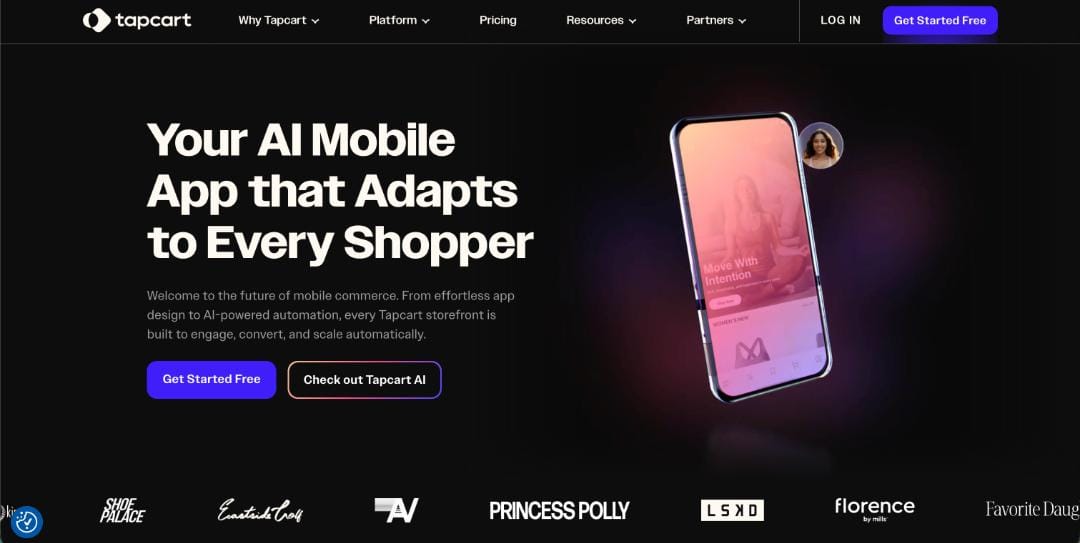
Tapcart is one of the most popular Shopify mobile app builders backed by significant venture funding and a large marketing footprint. If you have searched for mobile app solutions for Shopify, you have probably come across Tapcart already. The platform builds native iOS and Android apps with a drag-and-drop editor and offers real-time sync with your Shopify store.
Tapcart's strength is its stability and reliability. The platform has been around since 2017 and has invested heavily in making sure apps work consistently across different devices and operating systems. The drag-and-drop editor uses pre-designed blocks that are thoroughly tested, which means you are unlikely to run into bugs or crashes. For merchants who prioritize a stable, polished app experience over deep customization, this trade-off can make sense.
The platform includes unlimited push notifications and integrates with popular Shopify apps like Klaviyo for email marketing and various loyalty and reviews tools. The team also provides support for app store submission and offers dedicated account managers on higher-tier plans.
Where Tapcart falls short for some merchants is in pricing and customization flexibility. Plans start at $200 to $250 per month as a base subscription, but Tapcart also charges performance-based fees tied to your in-app revenue. As your app sales grow, these fees can add up significantly on top of your monthly subscription. The template-based approach also means your app may end up looking similar to other stores using the same platform, and merchants on lower-tier plans are limited in how many integrations they can add. If you need more than three plugins and are not on the Enterprise plan, you will need to upgrade to access them.
Tapcart works well for established brands with larger budgets who want a stable, premium app experience and are comfortable with success fees scaling alongside their revenue. For merchants who want flat pricing, deeper customization, or more flexibility with features and integrations, other options may be a better fit.
If Tapcart isn't the right fit, our roundup of the best Tapcart alternatives breaks down eight platforms worth considering instead.
3. Shopney
Shopney positions itself as a mobile app builder focused on ease of use, attractive design themes, and in-app live chat functionality. The platform offers a drag-and-drop editor with multiple pre-built theme options designed for different store types, and it supports real-time Shopify sync so product and inventory changes reflect automatically.
It also provides unlimited push notifications on all plans and supports multiple languages for international merchants, making it appealing for stores selling across different regions.
The platform has earned strong reviews for customer support and the speed of getting an app launched, with many merchants reporting they can go from setup to live app in less than a week. The live chat feature is a differentiator that lets merchants engage with customers directly inside the app, which can help convert hesitant shoppers and provide real-time support. Shopney integrates with popular Shopify apps, including Klaviyo, Yotpo, Smile.io, Gorgias, and Growave, bringing essential tools into the mobile experience.
That said, Shopney does have limitations worth considering. Features like scheduled and abandoned cart notifications are only available on higher-priced plans, which means stores on the entry-level tier miss out on one of the most effective notification types for driving revenue. Full design customization is locked to the Platinum plan at $599 per month, and most integrations require the more expensive tiers as well. Pricing starts at $149 per month and ranges up to $1,299 for enterprise-level support with an account manager.
Shopney also does not carry the "Built for Shopify" badge, which indicates it may not meet Shopify's highest standards for performance and integration depth. The platform works best for merchants who prioritize ease of use and attractive templates over deep customization, and who want live chat functionality built directly into their app.
4. Plobal Apps
Plobal Apps is a no-code mobile app builder with a strong focus on analytics, automation, and personalization features. The platform offers a drag-and-drop interface for building native iOS and Android apps, unlimited push notifications on all plans, and real-time sync with your Shopify store. One area where Plobal stands out is its analytics capabilities, which provide detailed insights into user behavior, revenue performance, and engagement trends directly inside the platform.
The platform carries the "Built for Shopify" badge, indicating it meets Shopify's highest standards for quality, performance, and integration. Plobal integrates with popular tools, including Klaviyo, Yotpo, Recharge, and various review and loyalty apps, and it has been around since the early days of Shopify mobile app builders, which means the platform has had time to mature.
Reviews often mention the team's willingness to get on calls and provide customized support, and some merchants have reported using the platform for five or more years with consistent results.
Pricing starts at $199 per month for the Growth plan with four standard integrations, and scales up to $499 per month for the Essential plan with user-segmented notifications and a dedicated success manager, and $1,199 per month for Enterprise with unlimited advanced integrations and priority support.
The tradeoff with Plobal is complexity. While the platform offers more flexibility than simpler app builders, it also requires more setup and ongoing work to get the most out of it. Some notification types and advanced features are reserved for higher tiers, and critics note that finding detailed information about the platform can be difficult because the documentation is not always well organized. Plobal works best for data-driven merchants who want strong analytics and are willing to invest time in optimizing their app's performance.
5. MageNative
MageNative is one of the most budget-friendly options for Shopify merchants who want to test the mobile app channel without a significant upfront investment. Plans start at just $49 per month, making it accessible for smaller stores or early-stage businesses that want to explore mobile commerce before committing to more expensive platforms. The platform offers a drag-and-drop editor, unlimited push notifications, multi-language and multi-currency support, and real-time sync with your Shopify store.
One feature that sets MageNative apart is augmented reality support on premium plans, which lets customers visualize products in their space before purchasing. The platform also includes AI-based product recommendations, social login options, and integrations with tools like Yotpo, Growave, Algolia, and various review apps. Reviews frequently highlight the customer support team as responsive and helpful, with many merchants noting that the team guided them through the entire process of publishing to both app stores.
The limitations become more apparent as stores grow. MageNative is best suited for straightforward Shopify setups, and the builder and layouts are more rigid than what premium platforms offer. Handling complex themes or heavy app stacks can be challenging, and some features like in-app chat and abandoned cart alerts are only available on higher plans.
Stores that need deep customization or have more advanced requirements may find the platform restrictive. MageNative works best as a starting point for budget-conscious merchants who want to dip into mobile without breaking the bank, with the understanding that they may need to graduate to a more feature-rich platform as their business scales.
6. MobiLoud
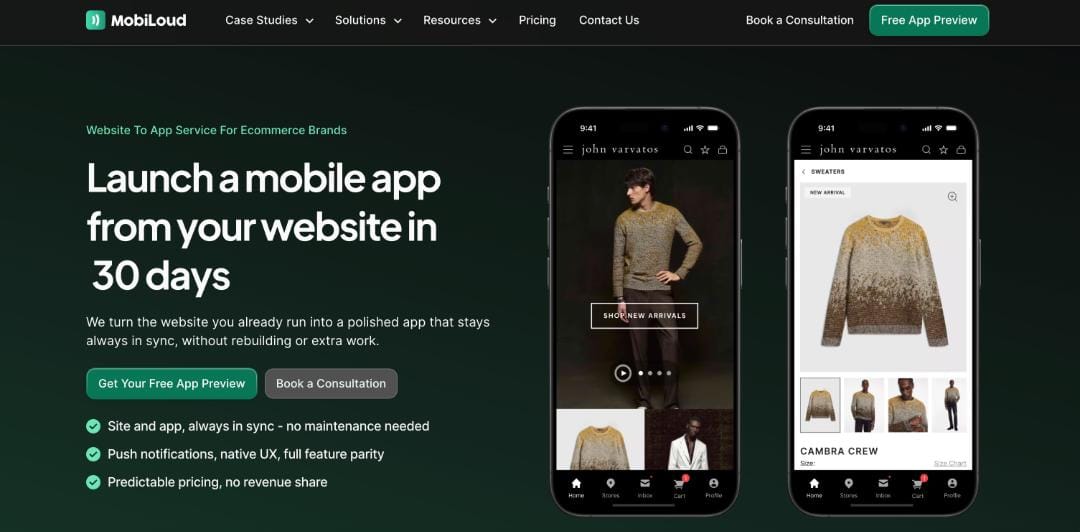
MobiLoud takes a fundamentally different approach than other app builders on this list. Instead of asking you to rebuild your store inside a drag-and-drop editor, MobiLoud converts your existing Shopify website into a native mobile app.
Everything you have already built and optimized on your website, including your theme, product pages, collections, checkout flow, and third-party integrations, works automatically in the app without any rebuilding required. This means any update you make to your Shopify store immediately reflects in your app, eliminating the dual-management burden that comes with traditional app builders.
The platform operates as a fully managed service, which means the MobiLoud team handles app configuration, store submission, and ongoing maintenance for you. This significantly reduces internal workload compared with DIY builders that require a team member to manage the app's design, content, and updates.
MobiLoud also works with all Shopify apps and third-party tools, including complex custom integrations that template-based builders often cannot support. For stores running headless setups or non-standard configurations, this compatibility can be a major advantage.
The tradeoff is a higher upfront cost and a slightly longer launch timeline. Plans range from $299 to $949 per month, with a one-time setup fee of $850 to $1,500. Launch typically takes two to four weeks, not a few days. There is also no drag-and-drop builder, so merchants who want granular control over app-specific layouts will not find that here.
MobiLoud works best for established brands that want a high-quality mobile app without building and managing it themselves, and that already have a well-optimized mobile website they want to extend to app stores.
7. Shop2App
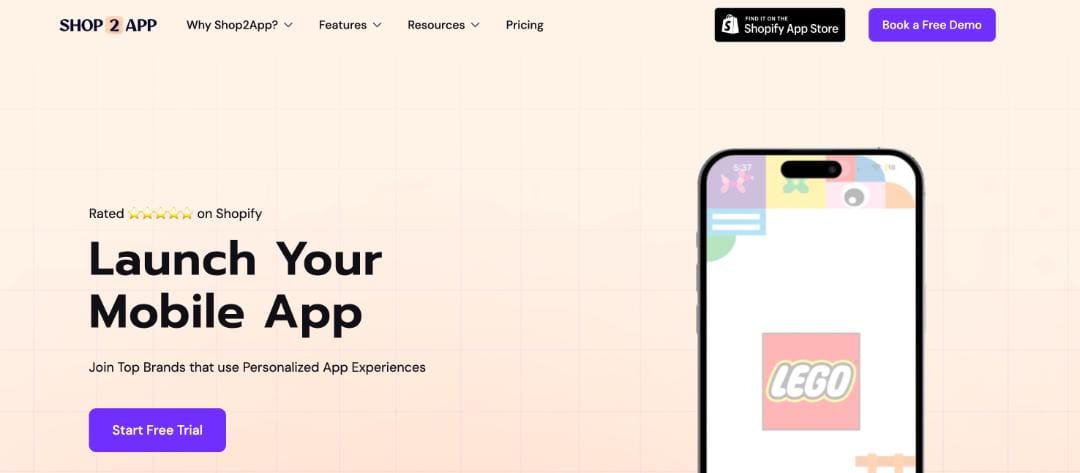
Shop2App markets itself as an alternative to Tapcart, Shopney, and Vajro, with a particular strength in subscription management and B2B functionality. The platform offers a drag-and-drop builder with unlimited push notifications, design blocks, and custom code capabilities for stores that require features beyond standard templates.
What stands out is the in-app subscription portal, which lets customers skip, pause, delay, swap products, update addresses, and change delivery frequency without contacting customer support for each minor change.
The platform integrates with Recharge, Klaviyo, Yotpo, Gorgias, Zapiet, and other popular Shopify apps, and reviews frequently mention the team's willingness to build custom features to fit specific business needs. Merchants with unique requirements, such as date- and time-based pickers for local delivery, store pickup functionality, or wholesale pricing, have reported success in getting Shop2App to accommodate their workflows. The team positions itself as a "growth concierge," and reviews suggest they take a hands-on approach to helping stores optimize their app.
Pricing starts at $299 per month for the Basic plan, which includes unlimited push notifications, design blocks, and onboarding support. The Growth plan adds custom product page blocks, two integrations, and a dedicated app designer, while the Enterprise plan at $1,299 per month includes white-glove development with a dedicated growth manager. This is a higher price floor than budget options like MageNative, but Shop2App targets established stores that need more customization and support rather than entry-level merchants testing the waters.
The platform works best for subscription-based businesses, wholesale operations, and stores with complex operational requirements that standard templates cannot accommodate.
8. Appbrew
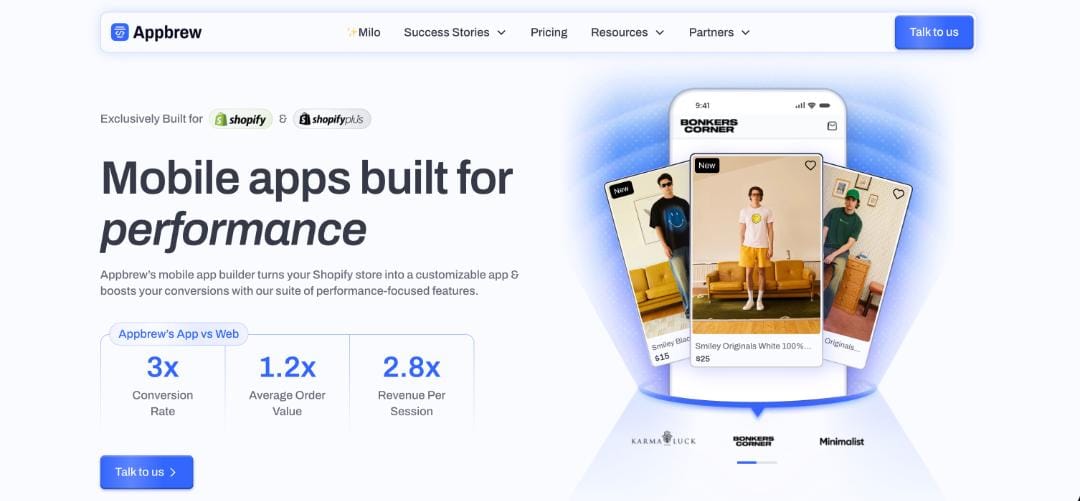
Appbrew targets established DTC brands that want high-performance, deeply customizable native apps with advanced personalization features. The platform is built on React Native, delivering faster load times and greater flexibility than template-based builders, and it offers over 100 native Shopify integrations, including tools for reviews, loyalty, subscriptions, and analytics. The drag-and-drop CMS allows extensive customization of layouts, branding, fonts, and colors, and the platform includes an AI concierge feature that provides personalized product guidance inside the app.
Where Appbrew differentiates is in its promotions engine and personalization capabilities. The platform supports tiered discounts, free gifts on orders, bundle offers, cart-based discounts, and one-click personalization using Shopify tags based on geographic location and purchase history.
For beauty and skincare brands, an AI skin analyzer provides product recommendations tailored to each customer's profile. Merchants consistently report significant improvements in conversion rates after switching to the platform, with some citing 3x higher conversion rates and 15-30% increases in average order value.
The pricing reflects the premium positioning. The Pro plan starts at $499 to $999 per month, depending on features, and Appbrew does not carry the "Built for Shopify" badge. Each store gets a dedicated customer success manager who provides strategic guidance and industry-specific best practices, adding value for brands that want hands-on support but is less relevant for self-service-oriented merchants.
Appbrew works best for larger, established DTC brands that require deep customization, advanced personalization, and extensive integrations, and that have the budget for a premium solution focused on performance optimization.
9. Hulk Mobile App Builder

Hulk Mobile App Builder offers a straightforward entry point for Shopify merchants looking to build native iOS and Android apps with a familiar interface. The platform is designed to mirror the Shopify customization experience, which lowers the learning curve for store owners already comfortable with Shopify's dashboard. It offers unlimited push notifications, social login, real-time sync, Google Analytics integration, Facebook deep linking, and a one-page checkout to streamline the purchasing process.
The app carries the "Built for Shopify" badge, indicating it meets Shopify's standards for performance and integration quality. Reviews consistently praise the customer support team for its responsiveness and helpfulness, particularly in custom integrations and the app store submission process. The platform handles publishing to both Apple App Store and Google Play, and merchants report that the setup process is straightforward even for those launching their first mobile app.
Pricing ranges from $79 per month for the basic plan to $399 per month for the enterprise plan, with a 15-day free trial. The platform uses flat monthly fees with no sales commission, so revenue generated through the app is entirely yours. The limitations primarily concern feature depth and breadth of third-party integrations.
Hulk primarily integrates with other HulkApps products and has fewer integrations with popular third-party tools than platforms like Appbrew or Plobal. For merchants with simple requirements who want an easy-to-manage app at a reasonable cost, Hulk provides solid value.
Stores that need advanced personalization, extensive integrations, or sophisticated automation will likely outgrow the platform as they scale.
Build Your Shopify Mobile App With Evlop
Choosing the right Shopify mobile app builder comes down to understanding where your store is today and where you want it to go.
For merchants who want the full package without the tradeoffs, that means deep customization, conversion-driving features on every plan, flat pricing that does not eat into margins as revenue grows, and real-time Shopify integration backed by the "Built for Shopify" badge, Evlop offers the strongest combination of value and capability.
If you are evaluating mobile app builders and want to see what your store would look like as an app, you can start with Evlop's free trial to explore the platform. The drag-and-drop customizer lets you build and preview your app in real time, and you can test it on your own device using a QR code before going live.
Once you've launched, our guide on getting the most out of your mobile app covers the tactics that drive the biggest revenue gains.
Ready to convert your Shopify store into a mobile app? Start your free trial with Evlop and see how quickly you can launch.