Superfans (formerly Vajro) is no longer positioning itself as just a mobile app builder. Instead, it has pivoted into a broad loyalty and retention platform built around VIP tiers, app-exclusive drops, live selling, and hands-on managed support.
For enterprise brands with deep pockets and budget to burn, paying for a massive, bundled retention hub makes sense. But if you care about ROI, an all-inclusive package isn't automatically the right move. Most stores end up subsidizing features they'll never use, while still hitting walls on the basics—like keeping custom store-specific web features intact and automating in-app customer journey flows without paying extra for integration software.
Why Shopify Brands Start Comparing Superfans Alternatives
The reason to evaluate a Superfans alternative is not that Superfans lacks features. It's that merchants want to scale their mobile channel without buying into an all-or-nothing enterprise model—usually for three main reasons:
- No room for gradual growth: Superfans leaves no middle ground between its $150/month Starter plan and $1,000/month Unlimited tier. You are left with a frustrating choice: either artificially cap your mobile growth at basic templates, or burn capital leaping straight to a $1,000/month tier just to unlock a couple of extra features. That means merchants pay enterprise rates for a vast catalog they barely use, rather than choosing a platform with practical tier limits and custom integration support tailored to their exact store needs.
Forced double development costs: Superfans lacks a self-serve way to retain store-specific web features—like custom product configurators, custom PDPs, or quiz funnels. Because building custom layouts on Superfans requires coding with their SDK or requesting custom development support, non-technical merchants can't do it themselves.
You end up paying developers or agency teams a second time, often at higher mobile app rates to rebuild what already works on your site.
- External software dependencies on automation: Superfans relies on third-party platforms to power key capabilities, like advanced behavior-based automations. This creates a hidden "stack tax" for merchants, who end up paying for a second software platform just to trigger campaigns based on overall shopper behavior and customer journey milestones—all on top of an already steep base plan.
This guide compares five Superfans alternatives for Shopify stores, starting with Evlop, our own Shopify mobile app builder, followed by platforms suited to different brands, budgets, and mobile commerce strategies.
1. Evlop
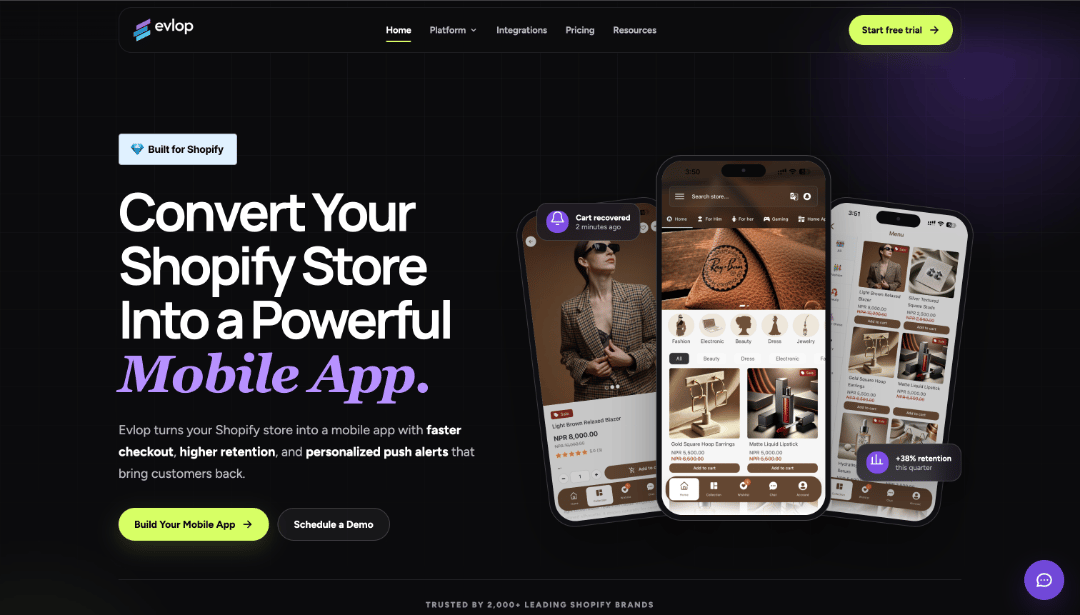
Evlop is an official "Built for Shopify" app designed for Shopify and Shopify Plus brands that want a native mobile app without giving up the storefront experiences, customer journeys, and custom capabilities that make their store unique. Merchants launch native iOS and Android apps with prebuilt design blocks, add custom features, and automate shopper journeys through Automation Flow—all while keeping proven web pages exactly as they are.
Evlop vs. Superfans: Key Differences
While both platforms allow Shopify merchants to launch iOS and Android apps, their underlying architectures and pricing philosophies are fundamentally different.
Here is how they compare across four critical areas:
1. Retain your proven Shopify pages instead of rebuilding them
Superfans: Supports embedding web content through basic URL-based blocks inside the app. Because these blocks load the full webpage—including site headers, footers, popups, and announcement bars—they introduce visual clutter (like double headers) and add page latency from processing heavy, redundant web scripts.
Evlop: Uses a Web Bridge SDK to render your existing, high-converting Shopify pages directly inside the native app frame — no rebuild, no added latency. By automatically stripping out website headers, footers, and extra popups, it isolates only the core page body content inside the app frame, eliminating the visual clutter and latency of standard web embeds.
For example, merchants can:
- Preserve custom PDP experiences directly from web to app — keep custom options, bundles, size guides, pricing rules, and Shopify Markets logic exactly as they already work on the web.
- Keep key landing pages synced automatically — Reuse existing Shopify landing or collection pages so new edits or promotional updates publish across both sales channels at once—no manual rebuild required for the app.
This protects the conversion rates already earned on proven pages, and avoids paying twice to retain features that already convert. The Web Bridge SDK comes standard on every Evlop plan starting at $99/month, with more pages unlocked on higher tiers.
2. Build new native experiences without waiting on developers
Superfans: Customizing layouts beyond pre-built templates typically requires a development support ticket, an account-management request, or a forced upgrade to a higher tier—creating constant bottlenecks for design and marketing teams.
Evlop: Beyond pre-built layouts and design blocks, merchants can turn any section idea into a working app section using Custom Blocks, whether it's a unique header, footer, custom product layout, or collection display, previewed live and reusable across any page. No coding background may required; merchants describe what they want or can give an image reference with it, and the built-in AI assistant generates the layout from that prompt, with Evlop's own team on hand for extra support.
That puts the shape of the app in the merchant's hands — brand identity, customer experience, the way the store actually works.
What this means in practice:
- Build a bundle-and-save block — let shoppers assemble their own kit or gift box and watch the discount apply live as they add items, without leaving the page.
- Add a size and fit finder — help shoppers pick the right size before they buy, cutting down on sizing-driven returns.
- Show real-time store availability — for brands with physical locations, let shoppers check which nearby store has an item in stock before ordering or reserving it for pickup.
- Or, execute any idea you have in mind.
This keeps custom development within the same builder merchants already use, rather than routing every change through a support ticket. Evlop includes Custom Blocks with AI from its Professional plan, starting at $249/month, well below Superfans' enterprise-only tier, where comparable customization lives.
3. Manage shopping journeys without a separate automation platform
Superfans: Handles single-trigger notifications, like a cart reminder or a restock alert, natively. For multi-step journeys that branch based on more than one condition, sending a different follow-up depending on cart value and customer type, for example, Superfans requires connecting a separate tool like WebEngage. That adds a second monthly cost and a second platform to configure, on top of the Superfans subscription itself.
Evlop: Includes a native visual Automation Flow builder directly inside the app platform, no separate automation platform required, at any level of complexity. Instead of just reacting to app events, Evlop evaluates custom behavioral rules in real-time before deciding how to respond.
Evlop Automation Flow works like this in practice:
- Trigger — a shopper adds an item to their cart.
- Condition check — Evlop checks the cart total against your free-shipping threshold.
- Action — based on what it finds, the flow can show an in-app popup, send a targeted push notification, open specific app pages/screens, or simply do nothing.
Built-in journey controls:
- Branching paths — send VIP or repeat customers down dedicated conversion flows separate from first-time shoppers.
- Frequency caps — limit how often the same shopper sees a prompt on the same events, so it never feels repetitive.
Why native behavioral data wins:
Behavioral automation is only as effective as the data driving it. Third-party tools rely on external webhooks and synced event layers, which introduce latency, data loss, and incomplete session context.
Because Evlop’s automation engine is built directly into the app platform, it processes live customer behavior at the source—capturing cart updates, screen views, and user intent in real time to deliver faster, far more accurate triggers than an outside app ever could.
See Whether Shoppers Are Coming Back
Evlop’s analytics dashboard combines retention reporting with push delivery, notification opens, and push-driven revenue. Teams can monitor whether shoppers return, evaluate re-engagement performance, and use those results to improve their Automation Flows.
4. Pricing that scales with what you'll actually use
Superfans: Bundles its $1,000/month Unlimited plan around unlimited blocks, unlimited integrations, and unlimited landing pages. That's a strong offer for a store that will genuinely use all of it. For most growing brands, actual usage doesn't stretch that far; it's worth working out honestly before committing to the top tier.
Evlop: Builds plans around what a typical store actually uses ($99–$499/month), covering the same ground without requiring the top tier to get there:
- Design Blocks: Unlimited design blocks come standard on the $99/month Starter plan, the same layout flexibility Superfans reserves for its $1,000/month tier.
- Integrations: Most stores run one review tool, one loyalty app, and one subscription service at a time, so a deep catalog of unused integrations matters less than having the right ones ready. Evlop includes core integrations natively and offers custom integration support for anything else you need.
- Custom Landing Pages: Mobile shoppers want fast, focused navigation—core store pages handle over 95% of sessions. Merchants rarely build more than 3–5 dedicated promotional pages a year. Evlop provides 3 custom landing pages on Starter ($99/mo), 8 on Professional ($249/mo), and 25 on Business ($499/mo)—easily covering the needs of custom landing pages without a $12,000/year enterprise bill.
In practical terms:
- Real design flexibility starting at $99/month, without needing the top tier to get it.
- A plan that scales with what your store actually uses, instead of a fixed bucket sized for stores that need more than most do.
"The right pricing model is the one that matches what your store will actually use, not one built around capacity most stores won't touch."
Start a 14-day free trial | Schedule a demo
Worried About Switching From Superfans (Vajro)?
Switching mobile app platforms shouldn't put your active revenue, app store ratings, or customer base at risk. Evlop provides a zero-downtime, white-glove migration path built specifically to protect your existing app equity:
- Keep 100% of your users & reviews — Direct binary updates preserve active installs, app store ratings, and push subscribers—no forced re-downloads.
- Preserve VIP tiers & behavioral automations — Existing behavioral segments and VIP logic are rebuilt directly inside Evlop Automation Flow.
- Retain custom web features without rebuilding — Subscription portals, quizzes, and custom pages convert seamlessly with Evlop’s WebView Embedding (Web Bridge SDK).
- Zero app downtime — Your current app stays live while Evlop's team builds, configures, and tests your new app in a private staging environment. You only swap over once everything is verified and ready.
Real Proof: Shopify Plus Brands Making the Switch
When Shopify Plus brand Honeydew switched from Vajro, now Superfans, they needed to preserve active app users and engineer a custom B2B wholesale registration flow that Vajro couldn't support. Evlop's team built a complete B2B solution and updated their live app binaries with zero downtime.
Here's what Honeydew shared in their Shopify App Store review after making the switch:
"Easy-to-use app with a modern design, and the customer service is exceptionally friendly."
— Honeydew, Shopify App Store review
(Shopify Plus brand that migrated from Vajro / Superfans to Evlop)
Already running a mobile app? Request a free migration assessment to map out your transition before making a decision.
2. Tapcart
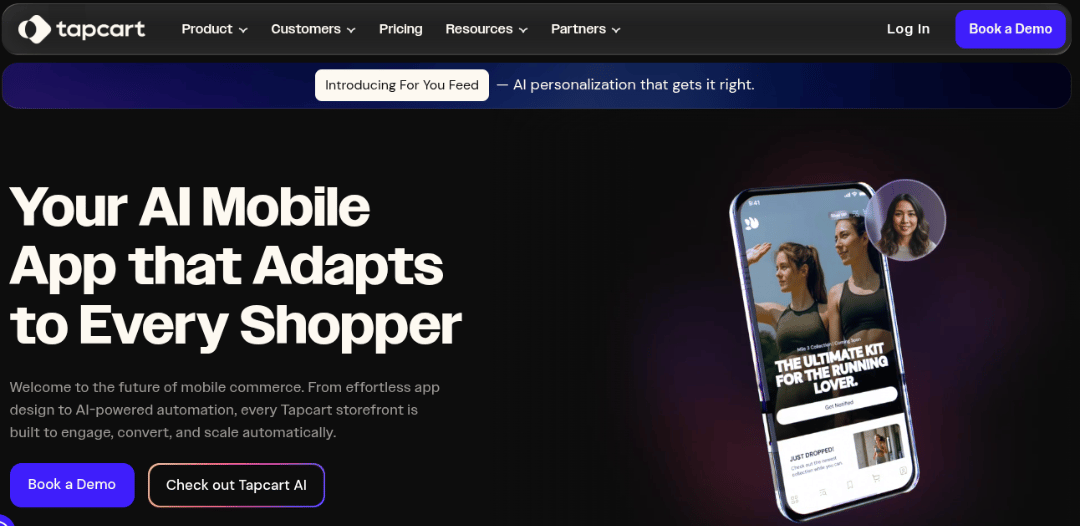
Tapcart is a widely used app builder tailored for high-volume Shopify and Shopify Plus brands. It relies on a large library of pre-built integrations with enterprise app support like Klaviyo, Nosto, and Yotpo.
- Customization Limits: Modifying app layouts beyond standard blocks requires developer knowledge. Creating unique page layouts or custom interactive features usually means writing code in custom developer blocks or hiring an agency.
- Push Automation & Messaging: Includes push scheduling and basic customer segmentation, but running multi-step behavioral campaign sequences requires routing data through external platforms like Attentive or Klaviyo.
Tapcart offers a 7-day free trial to build and test your store in App Studio. Paid plans start at $500/month (Growth) and scale to $1,250/month (Scale) and $2,850/month (Enterprise+), with an optional $250/month AI feature add-on. While it fits established brands with dedicated development budgets, ongoing custom work and developer tickets add to the total cost of ownership.
3. Shopney
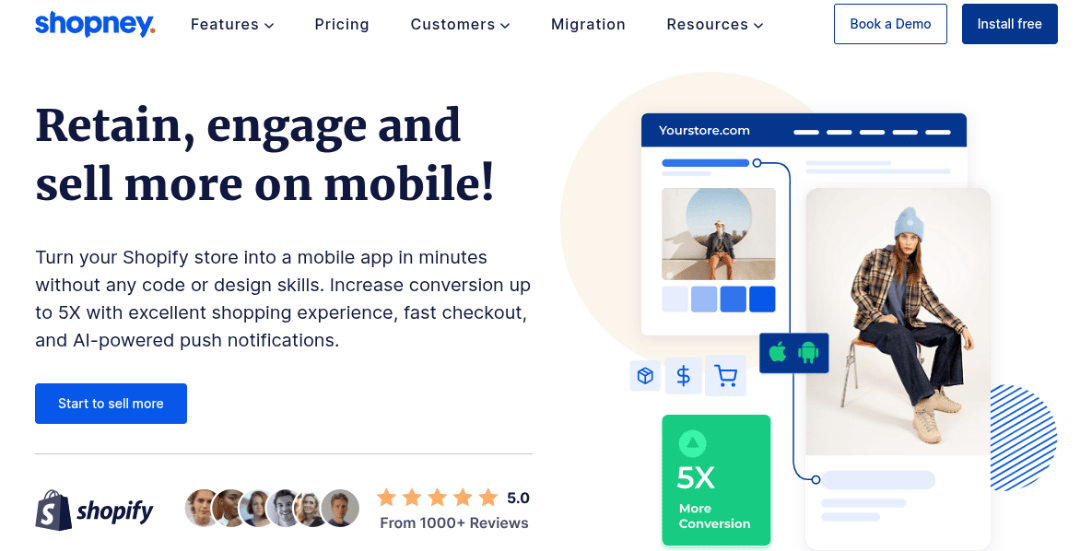
Shopney centers its platform around conversational commerce, making in-app customer support a primary channel for driving sales.
- In-App Live Chat: Connects directly with support tools like Gorgias, Zendesk, and Shopify Inbox. Support reps can chat with shoppers, send direct product links, and resolve questions inside the app interface.
- Design & Layout Constraints: Uses fixed design themes built for specific catalog styles. Setup is quick, but the heavy reliance on rigid visual templates makes it difficult to embed complex web tools or build non-standard landing pages.
Pricing starts at $149/month (Silver) and rises to $299/month (Gold) and $599/month (Platinum) to unlock automated push triggers, multi-currency display, and loyalty program integrations.
4. OneMobile
OneMobile targets entry-level Shopify stores that want to get an app live without hiring a dedicated designer.
- Design & Setup: The editor relies on a basic drag-and-drop builder paired with an AI assistant that drafts push copy, builds page layouts, and sets up promotional banners. Higher tiers add shoppable video feeds, barcode search, and automated cart recovery flows.
- Web Experience & Custom Tools: OneMobile lacks a Web Bridge SDK or custom webview tool. Unlike Evlop, it cannot carry over bespoke website features—such as custom subscription portals, sizing calculators, or unique web PDPs—into the app. Store managers are restricted to pre-built blocks, meaning complex web tools have to be abandoned or custom-built from scratch.
Beyond a basic free plan, paid tiers cost from $99/month to $990/month. The main trade-off is the revenue cap: once app sales pass monthly tier limits ($2,000 to $10,000/month), OneMobile adds a 1.2% to 2.9% transaction fee to every order.
5. Apptile
Apptile focuses on visual design control, using a modular, tile-based editor that lets store managers customize app screens without touching code.
- Tile-Based Layout Editor: Offers a library of over 300 customizable design tiles, allowing teams to build interactive feeds, product highlights, and promotional banners.
- Advanced Web Integration: While changing visual layouts is straightforward, connecting complex website tools (like custom size calculators or bundle builders) requires upgrading to higher tiers to access custom developer tile SDKs.
Pricing starts at $249/month (Pro) and scales to $499/month (Plus), with enterprise custom pricing for full SDK access. It fits design-focused stores that prioritize visual layout control over complex web feature bridging, though growing brands should keep in mind active user overage fees ($25 per 1,000 MAUs past tier caps) and video streaming usage charges.
[Pricing checked in September 2026. Plans, features, and usage-based fees can change, so confirm current details with each provider before making a final decision.]
Conclusion
Superfans can make sense for Shopify brands that want VIP tiers, app-exclusive drops, live selling, and managed support within one broad retention platform.
The decision becomes less straightforward when a brand needs to preserve custom Shopify experiences, build beyond predefined app blocks, or run and measure behavior-based customer journeys without managing another automation platform.
For those priorities, Evlop brings Web Bridge SDK, Custom Blocks, Automation Flow, and retention reporting into one platform. Its $99–$499 plans also let brands expand their mobile capabilities gradually instead of moving directly from an entry-level tier straight to an expensive enterprise package.
Switch to Evlop or launch fresh — fast, with hands-on support. Start your 14-day free trial.