

Tapcart is one of the most recognizable Shopify mobile app builders backed by significant venture funding and a large marketing footprint. This is why they are often one of the first platforms merchants find when looking for mobile app builders for their Shopify store. But it may not be the right fit for everyone.
We have spoken with merchants who found Tapcart’s customization options too restrictive for their brand requirements, and others who were frustrated by success-based fees that take a percentage of every sale made through the app. As revenue grows, those fees can compound quickly. In other cases, stores simply need features that Tapcart does not offer out of the box.
In this guide, we break down the best Tapcart alternatives, starting with Evlop, our own Shopify mobile app builder. We then cover other platforms that may be a better fit depending on your technical needs, customization requirements, and budget. If you're earlier in the process, our step-by-step guide on how to convert your Shopify store to a mobile app walks through the setup from scratch.
If you want a broader view beyond Tapcart specifically, our full roundup of the best Shopify mobile app builders covers these platforms and others side by side.
1. Evlop
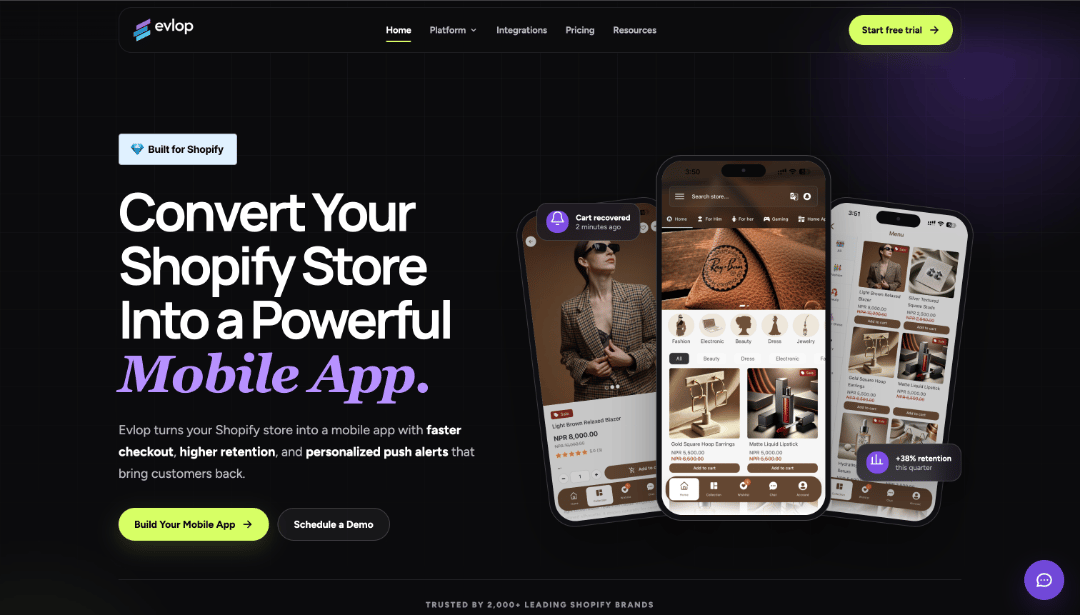
Evlop is a Shopify mobile app builder designed specifically for merchants who need more customization and control than template-based platforms provide. It builds native iOS and Android apps that sync automatically with your Shopify store, and the entire setup process can be completed in a few hours rather than weeks.
What makes Evlop different from Tapcart and other alternatives is the depth of customization available without requiring custom development. The platform includes pre-built templates for various industries including electronics, fashion, handmade goods, and organic products. But unlike templates that lock you into a specific layout, every element can be customized to match your exact brand requirements.
Building Your Mobile App with Evlop

The setup process starts with installing Evlop from the Shopify App Store. From there, you can either start from scratch or choose a pre-built template as your starting point. Since Evlop is built exclusively for Shopify, the templates automatically include eCommerce features like product catalogs, shopping carts, and checkout flows that integrate directly with your existing store data.
The customizer shows all the pages and components you can design for your mobile app. This includes core app pages like your home screen, product pages, collection pages, cart, user account, and wishlist. It also includes content pages like blogs and article details, plus navigation elements like your side menu, header, and footer.
You can add custom sections to any page using the section builder. This lets you create promotional banners, featured product carousels, countdown timers, and other elements that make your app feel unique rather than generic.
The real-time preview shows exactly how your changes will look on an actual device. You can also scan a QR code to test your app directly on your phone as you build it. This lets you experience the actual user flow and make adjustments before launching.

Built-In Features That Drive Conversions

Evlop includes features that would require third-party integrations or custom development on other platforms.
- Abandoned cart notifications remind users to complete their purchases if they leave the app mid-checkout, automated through Automation Flow so you do not have to manually trigger campaigns.
- Back in stock notifications alert customers when products they wanted become available again. This feature recovers sales that would otherwise be lost when popular items sell out.
- Product sorting and filtering helps users find products quickly. You can configure which filter options appear for different collections, making the browsing experience feel tailored to each product category.
- Multi-language and localization support lets you reach global customers by offering content in multiple languages. Combined with multi-currency support, this makes Evlop a strong choice for stores that sell internationally.
- Deep links and smart app banners drive mobile web visitors to download and use your app. When someone visits your mobile website, a banner can prompt them to open the same page in your app for a better experience.
- Behavior-triggered push notifications for price drops, new arrivals in categories a customer has browsed, and other personalized triggers — all built visually inside Automation Flow without writing a single rule by hand.
- Zip code checker verifies delivery availability for specific locations. This prevents customers from completing checkout only to discover you do not ship to their area.
- Product catalog pricing offers special pricing for B2B customers. If you sell both wholesale and retail, you can show different prices to different customer groups.
Integrations with Your Existing Shopify Apps

Evlop integrates with the Shopify apps you already use for marketing automation, customer support, social proof, and analytics. This means your loyalty program, reviews, and other features work in your mobile app just like they do on your website.
If you use Klaviyo for email marketing, your flows and segments carry over to push notifications in your app. If you use a reviews app like Judge.me or Loox, those reviews appear on your product pages in the app. The integrations are designed to work automatically once connected, so you do not have to rebuild your marketing stack from scratch.
App Store Submission and Publishing

Evlop handles the technical process of getting your app approved on both the Apple App Store and Google Play. You will need your own Apple Developer account and Android Developer account, which are required by Apple and Google for any app publisher. You will also need a Firebase account for push notifications to work.
Once you connect your accounts and provide the required credentials through the Evlop dashboard, you can request app builds for both platforms. Android builds generate instantly, while iOS builds take about 24 hours due to Apple's requirements. After building, Evlop helps with the submission process and tracks review progress on both platforms.
The entire process from setup to a fully published mobile app can take as little as a few days, depending on your store size and how many integrations you need to configure.
Why Evlop Stands Out from Tapcart
- No success fees: Evlop charges a flat monthly subscription without taking a percentage of your in-app sales. As your app revenue grows, your costs stay predictable.
- Deeper customization: While Tapcart offers templates and a drag-and-drop builder, Evlop provides more control over every aspect of the app experience without requiring custom development work.
- Built-in features vs. add-ons: Features like abandoned cart notifications, back-in-stock alerts, and B2B pricing are included in Evlop rather than requiring additional integrations or higher-tier plans.
Many of these conversion features run on Automation Flow, Evlop's no-code system for triggering actions based on real customer behavior — something most Tapcart alternatives either lock behind higher tiers or don't offer at all. - Dedicated support: Evlop's team will help you set up your app and customize it to match your needs. If you need functionality that does not exist yet, they will work with you to add it.
- True personalization: Unlike most alternatives, Evlop can reshape what each customer sees — read how in our piece on the Faceless App.
For Shopify Plus merchants and growing stores that need more than a basic app template, Evlop offers the best combination of customization, built-in features, and value.
2. Shopney
Shopney is a solid choice for smaller Shopify stores that want a straightforward mobile app without the complexity or cost of enterprise-level platforms. The app builder focuses on ease of use, with a simple setup process that does not require technical skills.
The platform offers several design themes that can be customized to match your brand. These themes include different layouts for product pages and collection pages, so you can choose the merchandising style that works best for your products.
Shopney includes an in-app chat feature that lets you communicate with customers directly. This can be useful for answering questions and providing support without requiring customers to leave the app.
The pricing is more affordable than Tapcart, making Shopney a reasonable option for merchants who want a mobile app but cannot justify the cost of higher-end platforms. The trade-off is fewer advanced features and less customization flexibility compared to platforms like Evlop.
Shopney works well for stores that need a basic but functional mobile app and do not require extensive customization or advanced automation features.
3. Plobal Apps
Plobal Apps focuses heavily on automation and analytics. The platform provides detailed reporting on app performance and user behavior, which can help you understand what is working and what needs improvement.
The push notification tools include automated campaigns that can be triggered based on various customer actions and behaviors. Personalized product recommendations are built into the platform to increase conversion rates by showing customers products relevant to their browsing history.
Plobal Apps offers in-app chat support for real-time customer interaction. The setup process is relatively quick with no coding required, and you can customize layouts to match your brand.
The platform charges a 1% success fee on its enterprise plan, which takes a percentage of all purchases made through the app. This pricing model can get expensive as your app revenue grows, but it also means lower upfront costs.
Plobal Apps is a reasonable choice for merchants who prioritize analytics and want detailed data on how customers interact with their app. The automation features can also save time on marketing campaigns once properly configured.
4. MageNative
MageNative provides a flexible mobile app builder with an intuitive drag-and-drop editor. The platform supports a wide range of customization options and integrations, giving merchants control over their app's appearance and features.
The builder does not require coding skills, so merchants can create and update their apps without technical help. MageNative supports various Shopify app integrations that extend functionality beyond the core features.
Pricing is typically more affordable than Tapcart, positioning MageNative as a mid-range option for stores that want decent customization without enterprise-level costs.
MageNative is a reasonable choice for merchants who want more control over their app design than basic platforms offer but do not need the advanced features of higher-end options. The drag-and-drop editor makes it accessible to non-technical users.
5. MobiLoud
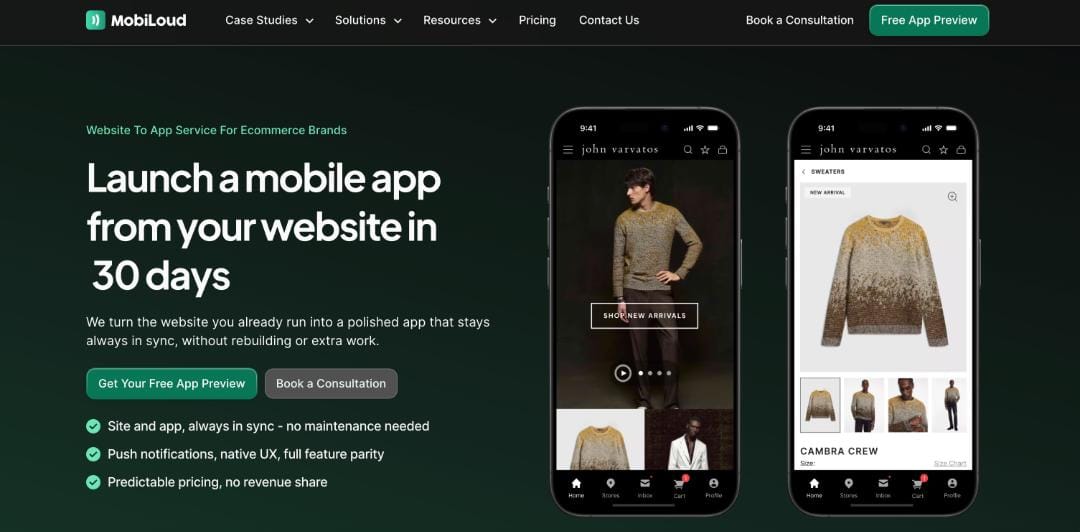
MobiLoud takes a different approach than most Shopify mobile app builders. Instead of rebuilding your store as a separate app experience, MobiLoud transforms your existing mobile website into a native app. Your website content and code are embedded in a native app wrapper that provides native performance and features.
This approach has advantages and disadvantages. On the positive side, everything from your website works in the app automatically. Any changes you make to your website appear in the app instantly. You do not have to manage two separate experiences or worry about integrations not carrying over.
On the other hand, you are limited by what your mobile website can do. If you want app-specific features or experiences that differ from your website, MobiLoud is more limiting than platforms that let you build a standalone app.
MobiLoud charges no success fees, and the service is fully managed. Their team handles the entire process, which can be valuable for merchants who do not want to spend time building and maintaining an app themselves.
MobiLoud is best for merchants who are happy with their mobile website experience and want that same experience packaged as a native app. It is also a good fit for stores with custom features or integrations that would be difficult to recreate in a separate app builder.
6. Shop2App
Shop2App positions itself as an enterprise-focused mobile app builder with extensive personalization options. The platform claims to increase customer engagement by up to 20% through its personalization features.
One of Shop2App's differentiators is in-app landing pages. You can create native app screens for collections, offers, educational content, and other purposes. These screens load quickly because they are native rather than web-based, and you can connect push notifications directly to them.
The platform does not charge success fees or commissions on app sales, offering transparent and predictable pricing. Shop2App's team handles the end-to-end process of designing and launching your app, including submission to both app stores.
Advanced analytics are included in all plans without extra cost, giving you detailed data on app performance. The platform also offers extensive customization options, including the ability to request specific custom development for unique requirements.
Migrating from Tapcart or another platform to Shop2App is designed to be seamless. Customer data, existing users, and push notification flows transfer securely, and customers do not have to reinstall the app.
Shop2App is a strong choice for enterprise brands that want extensive personalization and are willing to pay for a premium, fully-managed experience without success fees eating into margins.
7. Appbrew
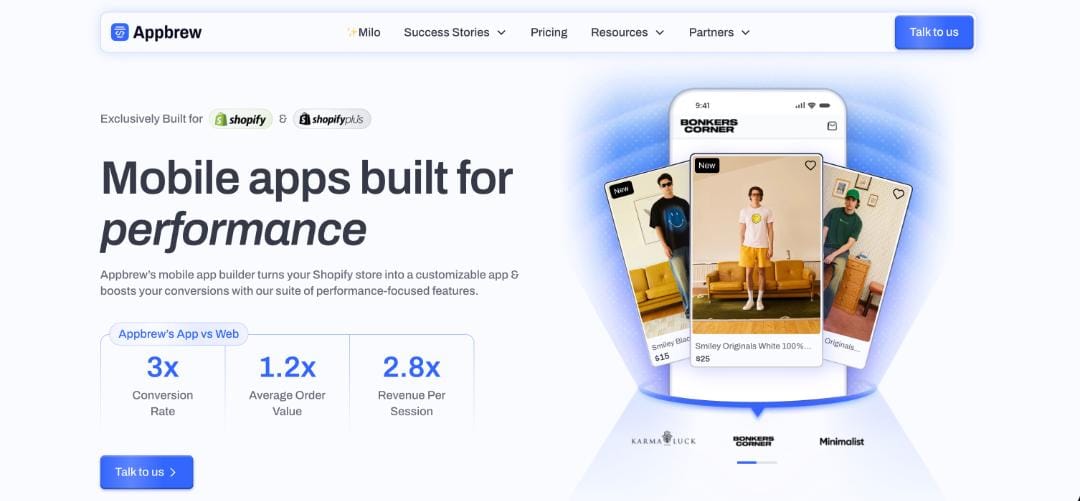
Appbrew offers a Shopify mobile app builder with a focus on advanced features and customization. The platform lets you convert your Shopify store into a fully native app for iOS and Android without coding skills.
Deep linking through Appbrew enables you to send customers directly to specific products or pages in your app from external sources like emails, ads, or SMS campaigns. This only works properly because Appbrew builds native apps rather than web wrappers.
The platform integrates with Klaviyo for automated push notifications, allowing you to use your existing email flows to trigger app notifications. Real-time data sync keeps your app updated with any changes to your Shopify store.
Appbrew includes tools for creating app-only promotions like flash sales and special discounts. These exclusive offers can drive app downloads and engagement, especially during busy shopping seasons.
With over 100 Shopify app integrations, Appbrew provides compatibility with most of the tools merchants already use. The platform is designed to scale with businesses of various sizes.
Appbrew is a good option for merchants who want advanced features like deep linking and Klaviyo integration, and who need compatibility with a large number of third-party Shopify apps.
8. Hulk Mobile App Builder

Hulk Mobile App Builder focuses on simplicity and accessibility. The platform offers a drag-and-drop editor that lets merchants create functional mobile apps without technical skills or coding knowledge.
The app syncs with your Shopify store in real time, so any changes you make to products, inventory, or pricing appear in your app instantly. This eliminates the need to manually update your app every time something changes on your store.
Hulk includes unlimited push notifications on all plans, which removes the concern about hitting notification limits during busy promotional periods. The platform also offers a customizable single-page checkout designed to reduce friction and improve conversion rates.
A built-in analytics dashboard provides basic performance tracking so you can see how customers interact with your app. The platform supports multiple languages and currencies for stores selling internationally, and integrates with popular Shopify apps and marketing tools.
One of Hulk's main differentiators is pricing. The platform offers affordable plans including a free tier, making it one of the more accessible options for smaller stores or merchants who want to test mobile app performance before committing to a higher-cost platform.
Hulk is a reasonable choice for merchants who prioritize simplicity and affordability over advanced customization or enterprise-level features.
Conclusion
The Shopify mobile app market has matured enough that you no longer have to settle for a platform that does not fit your needs. Take the time to evaluate what matters most for your store and choose accordingly.
If you need deep customization without hiring developers, Evlop offers the most flexibility along with built-in features like abandoned cart notifications, back-in-stock alerts, and B2B pricing that other platforms charge extra for or do not offer at all. The flat monthly pricing also means you keep more of your revenue as your app sales grow.
Ready to convert your Shopify store into a mobile app? Start your free trial with Evlop and see how quickly you can launch.